



Before You Double Revenue, Change Your Sales Engine
- November 25, 2026
- Posted by: Bizwin-2024
- Category: blog
No Comments
A ₹50 Cr company cannot necessarily become a ₹100 Cr company by doing twice as much of what it does today. At some point, the sales engine itself has to change.
“We want to double revenue in three years.”
It is an ambition many CEOs share. But the responses that follow are often predictable: hire more salespeople, generate more leads, enter new markets and add more products.
Each of these may contribute to growth. However, they all assume that the existing sales engine can simply be scaled.
The more important question is: Can your existing sales engine support twice the revenue?
An engine that is already leaking, forecasting poorly or depending on a few individuals does not become stronger when it receives twice as much input. It becomes a bigger version of the same problem, and more expensive to run.
Six Dimensions of a Sales Engine Built for Revenue Growth
When assessing whether a sales engine can support a company’s growth ambition, six dimensions matter. Each addresses a different aspect of revenue performance.
1. Demand: Do We Have Enough Qualified Demand?
Revenue growth requires sufficient qualified demand to support the target. Generating more leads is not enough if those leads do not represent genuine buying opportunities.
2. Conversion: Can We Convert More of the Demand We Already Have?
Before increasing lead generation, companies need to examine how effectively they convert existing demand. Improving conversion can strengthen revenue without simply increasing sales activity.
3. Sales Velocity: Can We Shorten the Buying Journey?
The time taken to move a prospect from initial interest to a buying decision directly affects how efficiently the sales engine produces revenue.
4. Productivity: Can Each Salesperson Generate More Revenue?
Revenue growth is also about improving the productivity of the existing sales team rather than relying entirely on increasing headcount.
5. Account Growth: Can Existing Customers Contribute More?
Existing customer relationships represent an important dimension of revenue growth. Companies need to assess how much additional business they can generate from their existing accounts.
6. Predictability: Can Management Reliably Forecast the Outcome?
Growth becomes difficult to plan when management cannot confidently forecast revenue. Predictability requires a sales engine that produces reliable outcomes rather than occasional good quarters.
A company can perform strongly in one or two dimensions and still struggle to double revenue. Strong demand with weak conversion produces considerable activity but modest results. Strong conversion with poor predictability produces good quarters that nobody can confidently plan around.
The engine works when all six dimensions work together.
Understanding the Revenue Engine
The revenue engine is a connected process:
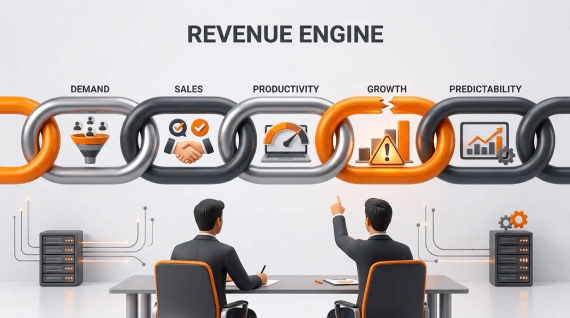
Demand Generation → Sales Conversion → Sales Productivity → Account Growth → Revenue Predictability
Growth is not driven by a single lever. It is a chain, and the chain is only as strong as its weakest link.
Doubling revenue means strengthening whichever link is likely to fail first under double the load. That is rarely the same area leadership is already focused on.

What the Revenue Growth Journey Requires
Looking at the different dimensions of B2B sales together reveals four important areas companies need to get right.
Understanding the buyer: Prioritising conversion before volume and recognising that buyers often arrive informed and later in their buying journey than salespeople expect.
Improving productivity: Understanding how AI changes the economics of selling, why revenue quality matters alongside revenue growth, and how to translate product value into business value.
Strengthening deal economics: Creating proposals that confirm buying decisions, growing existing customer accounts and building forecasts around customer evidence.
Thinking like a CEO: Treating margin as part of growth and designing a sales engine that can support the company's ambition.

The Role of AI in Redesigning the Sales Engine
AI makes redesigning commercial workflows more practical than it was a few years ago.
McKinsey’s 2026 research highlights seller efficiency and customer experience as key benefits when AI is embedded into core commercial workflows rather than added at the edges.
The objective is not to add more AI tools to an existing sales engine. It is to use AI to build a better one.
A company that adds tools to a leaking funnel simply gets a faster leak.
The goal is business impact, not the number of tools implemented.

Build a Sales Engine That Can Support 2X Growth
Growth does not happen simply because a company wants more revenue. It happens when the revenue engine is designed to produce it.
Wanting to double revenue is a target. Building a revenue engine capable of doubling it is a design.
Most companies spend considerable energy on the target and relatively little on designing the engine that needs to deliver it. The result is often a growth ambition that is difficult to achieve.
The good news is that the engine can be assessed, strengthened and redesigned in a structured way, one dimension at a time, long before the ambition is tested in the market.
You do not double revenue by doing twice as much of what you do today. You double it by building an engine that can carry twice the load.
If your company is targeting 2X growth over the next three years, ask yourself:
Is your current sales engine capable of delivering it?
Frequently Asked Questions
What is a sales engine in a B2B company?
A sales engine is the connected system through which a company generates demand, converts opportunities, improves sales productivity, grows existing accounts and achieves revenue predictability.
Why can’t a company simply double its sales activities to double revenue?
Increasing sales activities does not automatically increase revenue. If the existing sales engine has weak conversion, poor forecasting or excessive dependence on a few individuals, scaling the same activities can make the existing problems more expensive.
What are the six dimensions of a successful sales engine?
The six dimensions are demand, conversion, sales velocity, productivity, account growth and predictability. Together, they determine whether a company’s sales engine can support its revenue growth ambitions.
How can a company prepare its sales engine for 2X revenue growth?
A company should assess all six dimensions, identify the weakest links and strengthen the areas most likely to limit growth before increasing the load on the existing sales engine.
How does AI contribute to sales engine improvement?
AI can make commercial workflow redesign more practical by improving seller efficiency and customer experience when embedded into core commercial workflows. Its purpose should be to improve business impact rather than simply introduce more tools.
Why is revenue predictability important for business growth?
Revenue predictability enables management to reliably forecast business outcomes and plan for growth. Strong conversion without reliable forecasting can still result in good quarters that are difficult to plan around.
What is the revenue engine framework?
The revenue engine framework connects demand generation, sales conversion, sales productivity, account growth and revenue predictability. It highlights the importance of strengthening the entire revenue chain rather than relying on a single growth lever.
Is Your Sales Engine Ready for 2X Growth?
At Bizwin Consulting, we work with B2B businesses to strengthen their sales systems and build more predictable revenue growth.
Understand where your sales engine stands and identify the dimensions that need attention before your next growth milestone.
