


More accounts covered
Expand the addressable universe managed by each salesperson without a proportionate increase in cost.


The answer has significant implications for sales headcount, cost structures, competitive positioning, and how businesses fund growth. Yet many B2B leadership teams have not spent enough time considering what this shift means for their sales strategy.
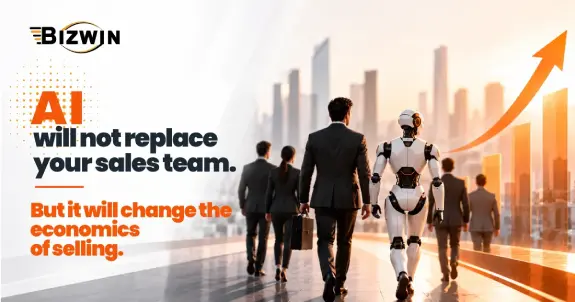
For most of the last two decades, revenue growth and sales headcount followed a relatively linear relationship. If a business wanted to increase revenue by 30%, it broadly needed to increase its sales capacity by a similar amount.
AI is beginning to disrupt this equation.
Traditionally, higher revenue targets required more salespeople, increasing the cost of sales before the expected revenue growth materialised. With AI, businesses can automate high-volume, low-judgement tasks and enable each salesperson to manage more pipeline.
The result is an emerging growth model in which revenue can increase without a proportionate increase in sales headcount, potentially reducing the cost of sales as a percentage of revenue.
AI can already meaningfully support several activities across a B2B sales workflow.
These activities consume considerable salesperson time that could otherwise be spent in meaningful buyer conversations.

If AI absorbs even 30–40% of this workload, the capacity released could be substantial. The opportunity is not simply to automate existing tasks, but to allow salespeople to spend more time on activities that directly support revenue growth.
Salesforce’s 2026 India research, as cited in the original article, reports that 91% of Indian sales professionals consider AI agents mission-critical, while 54% are already using AI for prospecting.
These figures highlight the growing importance of AI in sales workflows. However, adoption alone does not guarantee productivity gains.

AI should not simply automate existing sales activities. It should redesign how salespeople spend their time.
These are two different objectives. Automating a task may save time, but the real commercial benefit depends on how that time is redeployed.
Sales leaders need to decide where additional capacity will create the greatest value. Without that decision, even a well-equipped sales team may fail to realise the full potential of AI.

If AI gave your sales team 20% more selling capacity, where would you deploy it?
Expand the addressable universe managed by each salesperson without a proportionate increase in cost.
Spend more time engaging buying committees within high-value accounts instead of covering them superficially.
Reach decision-makers who are not currently being engaged consistently.
Increase buyer touchpoints, resolve objections sooner, and identify stalled opportunities earlier.
Invest more diagnostic effort at the top of the funnel so that unqualified opportunities do not consume resources further down the sales process.
There is no universal right answer. The right allocation depends on the organisation’s commercial priorities. However, leadership teams that have not discussed this question are not ready to extract meaningful value from AI, regardless of which tools they adopt.
AI is more likely to change how salespeople work than simply replace sales teams. By supporting repetitive, high-volume tasks, AI can help salespeople manage more pipeline and spend more time in meaningful buyer conversations.
AI can support account research, prospect identification, personalisation, meeting preparation, call analysis, CRM updates, follow-ups, proposal preparation, and opportunity intelligence. This can free up salesperson time for revenue-generating activities.
AI can help businesses increase sales capacity without proportionately increasing headcount. When salespeople manage more pipeline and spend their time more effectively, the cost of sales may decrease as a percentage of revenue.
According to the Salesforce 2026 India research cited in the article, disconnected data is the primary factor slowing AI adoption among Indian sales teams. Clean, connected data is essential to realising AI’s potential in sales workflows.
Businesses can deploy additional capacity towards covering more accounts, deeper penetration of high-value accounts, more CXO conversations, shorter sales cycles, or better qualification. The right choice depends on the organisation’s commercial priorities.
Sales leaders should determine how AI will change their team’s use of time, not just which tasks it can automate. The objective should be to improve sales productivity and commercial outcomes rather than automate existing activities without a clear strategy.
AI will not necessarily mean fewer salespeople. It will raise the productivity bar and widen the competitive gap between organisations that deploy it effectively and those that do not.
The future of B2B sales is about creating more productive salespeople, increasing the value of their time, and designing sales workflows around meaningful commercial outcomes.
For CEOs and sales leaders, the question is no longer simply whether to adopt AI. It is how to use the additional selling capacity to improve growth, competitiveness, and sales productivity.

Vipul Kukreja has over 36 years of experience in Sales and Marketing, Entrepreneurship, successfully Launching new ventures, managing Profit & Loss Account, motivating teams to achieve business goals and deliver customer value. After his M.B.A. in Marketing from the University Business School, Panjab University. Vipul started his career with Garware Paints Limited. As a management trainee and Sales Officer, he focused on achieving the company goal of making an entry in the B2B market in the state of Rajasthan, where the primary focus of the company was consumer segment.
His passion for Information Technology sector started when he joined Computer Point, India’s first one-stop outlet for everything in computers. He closely worked with his senior management in establishing the company in its formative stages to spearhead the adoption of computer systems in the corporate through Learning and Development. His former superiors and colleagues still reminisce fondly about his evangelizing usage of computers in over 1000 major corporates in the early years of computerization in India. He converted this market need for knowledge of technology into a highly profitable Computer Learning Division and ran it as a profit center.
At Silverline Technologies Limited, he replicated the computer training model, taking it to much larger scale, helping a fledgling IT company establish a pre-eminent name in the marketing of computer training and related solutions and software products. During this period, he designed, developed and delivered Sales Training Program for his team.
HA short stint in the U.A.E. with Jumbo Electronics computer division as Sales Manager gave him exposure to an international and multi-cultural market. Back in India, he took up one of the biggest challenges of his life as General Manager -Sales & Marketing for MicroGiga (a Mafatlal company) where with the help of his seniors and the board, he helped turn the company profitable in a short span of time, enabling it to become one of the largest business partners of Hewlett Packard from India, globally.
His last assignment in the corporate sector was Tata Consultancy Services where he played the role of the National Head for Software Products.
Over 2 decades ago, bitten by an entrepreneurial bug, he founded and launched an executive search firm, M2S Consulting. Within a short span, the company grew to become one of the biggest go-to brand names for Headhunting top management for the Information Technology sector in Mumbai. Vipul is a certified DISC Assessor, a Certified Business Coach, and a Certified Executive Coach.
A lifelong student of management, sales, marketing, business development, Vipul is a trained Digital Marketor too. As an entrepreneur, he empathizes with the businesses struggling to grow and is very passionate about helping business seek the business goals and dreams, they had set out for. As a mentor, advisor and execution partner his philosophy is co-creation of business outcomes.
Vipul is a charter member of The Rotary Club of Thane Skyline, where he served as a President too. He is an active member of the Rotary District 3142, contributing actively to the upliftment of the underprivileged. He is an avid reader and spiritually inclined. Integrity to self and the customer is his dictum and delivering value is the battle cry.
Married to Jyoti, Vipul happily lives with his mother and daughter Janhavi and son Vishrut.